Two Riots
The Battle for Seattle on film, 25 years apart

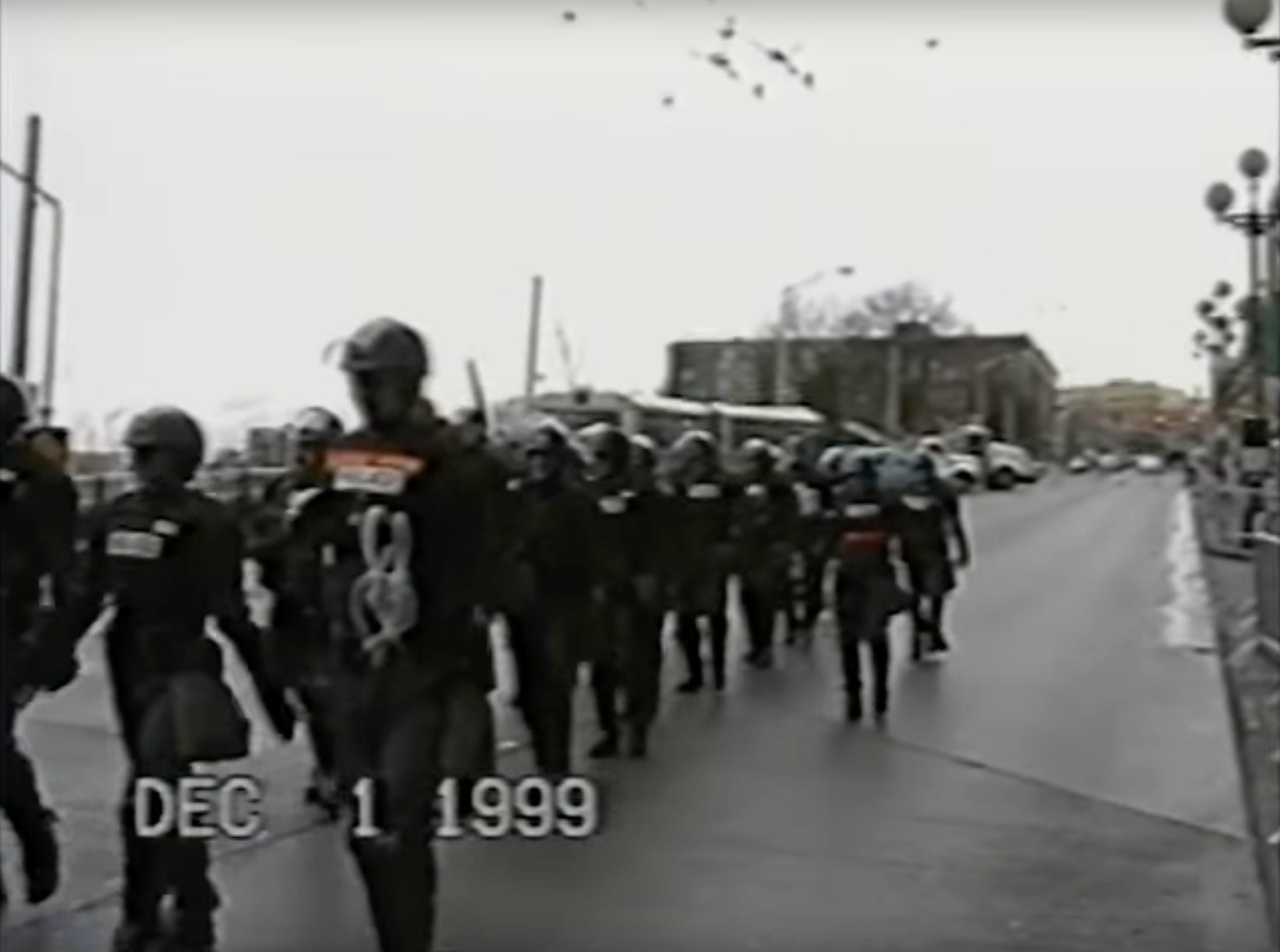
WTO/99 (2025)
Did you hear the one about the outside agitators? That felt like the punchline to the nuggets of humor located in WTO/99, a new archival documentary on Seattle’s anti-World Trade Organization protests. It’s no comedy, though; exiting the theater, my friend and I commented that our bodies were in a fight or flight response after watching scene after scene of police officers bludgeoning protestors with clubs and pepper-spraying them at point-blank range. By the second half of the film, once the property damage kicks off in response to police brutality, the “violent protestors” rhetoric predictably enters the chat, and there’s a ludicrous rhythm to its repetition on the included news recordings. Though the movie is solidly under two hours, the footage felt endless, and at a certain point I found myself thinking “enough already.” The overarching feeling I was left with after watching was an increased hatred for the police, which, frankly, I hadn’t thought was possible, so I have to give credit to the filmmakers (directed by Ian Bell, edited by Bell and Alex Megaro) on that elicitation.
In contrast, This is What Democracy Looks Like (2000), directed by Jill Friedberg[1] and Rick Rowley shortly following the event itself, runs at just one hour and twelve minutes, though the amount of perspective and information it manages to pack into the time is staggering. Despite the fact that the two films often use the very same clips, they take distinctly different approaches. This is What Democracy Looks Like is just as ambitious in its sourcing of protest footage, employing tape from over 100 media activists, but is structured more in the documentary format most of us are likely used to, with event footage interspersed with talking head interviews from a range of participants. This is enlivened with a decidedly 2000s spoken-word voice-over[2], graphics of grids and globes and text that punctuate the film’s acts, and a galvanizing soundtrack that serves as a time capsule of counterculture at the time (Rage Against the Machine, DJ Shadow).
I’m an oral historian; I live for archival media. Making the 2025 film solely from archival video keeps the aesthetic qualities of 1999 intact; it preserves an artifactual view of mainstream news at the time. The accumulation and sourcing of so much footage is formidable—in a particularly noteworthy scene, police and legal observers are filming each other with handheld camcorders from a distance, and the filmmakers have managed to locate and stitch together both perspectives, offering us a sense of completion around that particular moment. But relying so heavily on news footage, and as a result, on protestor voices through the lens of reporters’ interview questions, stages a defensive position for the protestors rather than offering a view of the offensive strategy they so consciously mounted (organizers planned for the disruption for over a year leading up to the event).
Upon rewatching This is What Democracy Looks Like, I was also struck by the degree to which WTO/99’s represented voices were white. One can imagine that this was a result of news media bias, by who on-the-ground crews sought out and centered in their documentation, but it begs the question of responsibility to full and representative renderings of an event that don’t simply reproduce hegemonic narratives. An additional consequence of this sourcing is that the view is a distinctly American one, a fact that downplays at best, and discredits and erases at worst, the international solidarity at the very marrow of the global WTO opposition coalition.
The protestors ultimately feel brave and bright-eyed but politically unsophisticated, their sound bites reduced for the most part to humanistic opposition rather than material systemic analysis like what’s on offer in TIWDLL. One notable theme that emerged among the way protestors were represented in WTO/99 was a sort of earnest belief in, and appeal to, a democratic logic structuring police’s limitations. I lost count of the number of times protestors cited the Constitution, the Supreme Court, or the law in general as an admonishment of the police’s behavior. There’s a painful quality to watching people appeal to humanity and reason in the face of calculated brutality. As a viewer seeing this as a new release in 2025, it initially wedged an implausible distance between current events and the film’s subject rather than closing the gap between contemporary and historical flashpoints; I figured we all tend to know by now that violence is baked into the judicial system. Upon further reflection, though, it made me think of the recent No Kings protests and the project to redeem American democracy, believing it to be Saveable and Fundamentally Good rather than a doomed settler colonial project, taking to the streets with oversized banners of the founding documents and effigies of bad presidents on pikes.
Having seen TIWDLL before WTO/99, the motivations felt incomplete, knowing as I did how much more there was to the story, which begged the question: are WTO/99’s filmic goals aesthetic or informational? There were useful details that were new to me, as in the gruesome fact that Seattle PD’s tear gas supply ran out, forcing them to source more from corrections departments and nearby cities and finally by flying to other states to re-up, so completely did they douse the city with chemical agents. Other useful information featured in scenes where protestors who had collected so-called “less-lethal” munitions displayed them and explained how they were used and their effects; later on in the film the police catalog the same weapons, downplaying their consequences to a nauseating degree.
At its end, the film includes footage of anti-globalization solidarity protests that emerged the world over following Seattle 1999, suggesting to viewers that this event marked the inflection point and beginning of a widening movement. Though it employs a near-identical montage of worldwide protests at its end, This is What Democracy Looks Like begins its film with scenes from protest movements like the 1994 Zapatista uprising and 1995 strikes in France, from which emerged anti-globalization organization ATTAC, placing Seattle 1999 along a continuum of mobilization rather than framing it as the perceived originator.
But that’s the news, folks, seems to be the approach WTO/99 is taking, offering up a smorgasbord of narrative parts and trusting consumers to have a discerning palate. Is that a consciousness we can expect the average viewer to possess when watching? If the unyielding onslaught of thinkpieces about our collectively declining media literacy and the terrifying, rapid-pace circulation of undetectable deepfakes suggests an answer, it’s probably not. Without broader contextualizing details and perspectives, the film sells short the sharpness of preparation and responsiveness of the protest movement, as in a scene that shows a sit-in outside the jail arrested demonstrators have been taken to. If you watch TIWDLL you’ll not only learn that organized labor threatened to shut down the city’s ports if the detainees weren’t released, and that international prisoner solidarity demonstrations immediately kicked off, you’ll also be treated to stirring demonstrations of the people’s mic by movement lawyers and Tom Hayden of the Chicago 7 (“I never thought the time would come that a new generation of activists would part the waters, the waters in which your idealism is supposed to be drowned, and come to the surface, smiling, fighting, laughing, dancing, marching, committing civil disobedience…”), both crucial to the story and spirit of the moment.
A favorite element of This is What Democracy Looks Like is its inclusion of two moments in which protest chants are reduced to single-word invocations, one in which, as seated and locked-arm protestors wait for the police to bear down on them with mace canisters, they begin to chant “COURAGE! COURAGE! COURAGE!” to shore up one another’s resistance.[3] The other is a collective cry simply of the word life again and again, “Life! Life! Life! Life!”, perhaps the most effective distillation one could imagine of the demands of the 50,000 person strong resistance movement—an insistence on life, on people over profit, against the death-dealing machine of globalization and capitalist imperialism.
My one critique in rewatching TIWDLL is that the narrative emotional structuring of the film is somewhat unusual in that it, at multiple points throughout, feels as if its themes have come to a satisfying conclusion and that the end credits are about to roll, only to begin again with a fresh act. But perhaps this is a productive trick of the filmmakers approach to editing; it resists a single, neat resolution and insists on there being multiple renewable lessons to be learned.
Look, I’m biased. I cry every time I watch TIWDLL, but here, I’d argue that’s indicative of a film that, even twenty-five years after the fact, generates an impactful and somatic response in the viewer. Rewatching it today, rather than leaving me feeling simply white-hot rage at the police, I was hopeful and galvanized thinking of the year of organizing victories that the successes at the Battle for Seattle generated, the gust of effectiveness in the people’s sails. The incisive critique and perspectives offered by the people of TIWDLL still feel useful and true, and this, to me, is the purpose of movement documentation. When given the choice, I’ll always take the film that leaves me wanting to take to the streets, loudly shouting “Life! Life! Life!” with my friends.
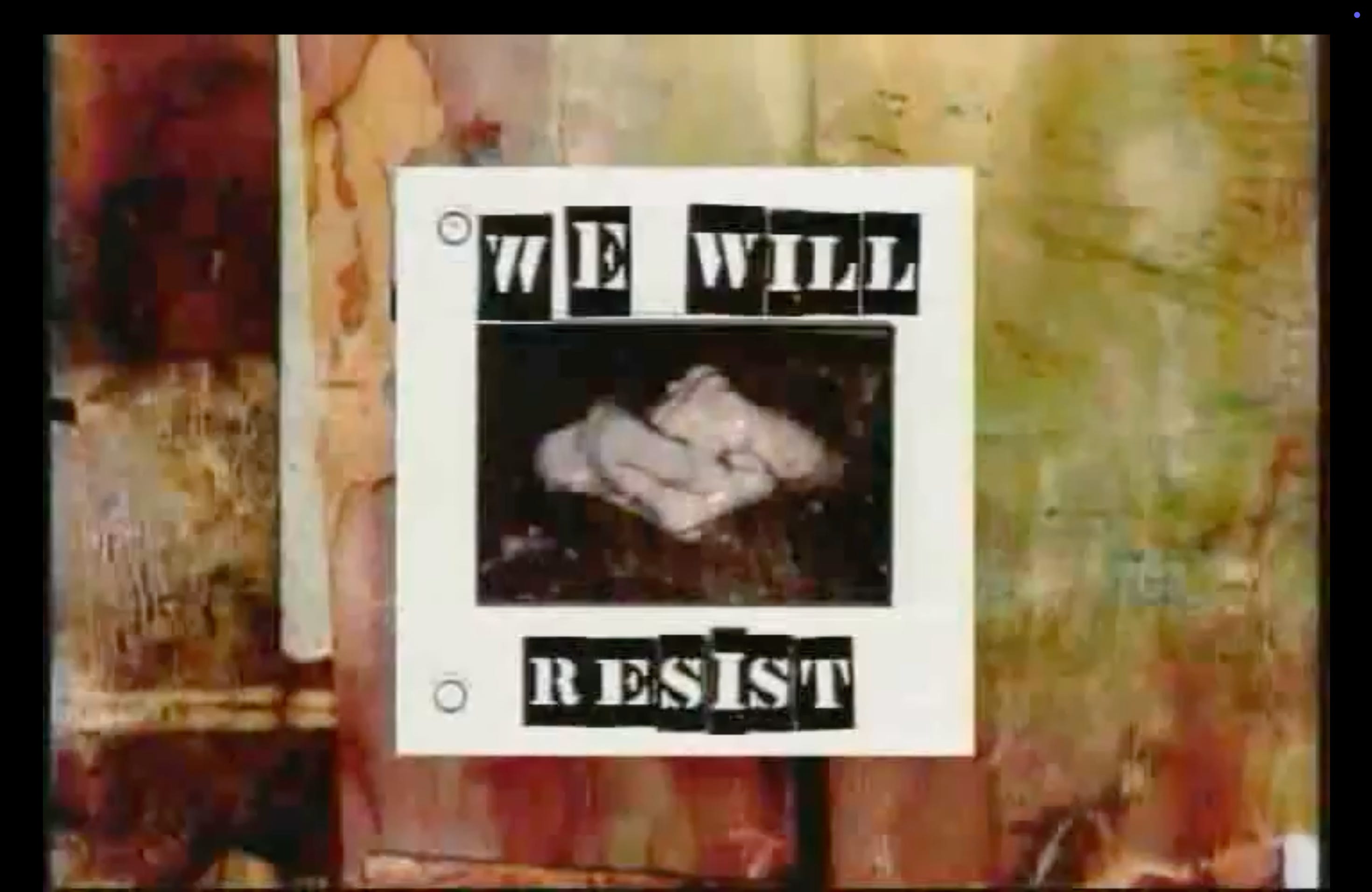
This is What Democracy Looks Like (2000)
[1] It feels significant and relevant that Jill Friedberg is herself an oral historian as well as a filmmaker, and that she is a co-director at the Seattle Black Spatial Histories Institute at Wa Na Wari, an incredible art and community landmark.
[2] One of the narrators is Susan Sarandon, further proving that she has always been, and continues to be, a real one. In a visit to the Albany State Archives, I found materials documenting her support of the Attica Brothers in the 70s. We love you, Susan <3
[3] It calls to mind a particularly powerful moment in the CalPoly Humbolt Gaza solidarity protests where students chanted “We are not afraid of you! We are not afraid of you!” as riot police tried to breach the building they occupied.